
Looking for a reliable data management system to manage your data?
Read these frequently asked questions about AS400 DB2 or AS400 (Application System/400) database – a popular data management system by decision-makers and decide for yourself.
1. What is AS400 DB2, and What Purpose does it serve?
AS400 DB2 (now DB2 for IBM i) is an integrated relational database management system within AS400 operating system (now IBM i). Unlike traditional database systems, you don’t need to install or maintain it explicitly.
DB2 is a database management system also referred to as DB2 AS400. It is known for its multi-support and security components.
AS400 Db2, or Database 2, is a group of relational database products designed and offered by IBM.
You may wonder, why is it called relational.
Well, because everything in this database is a relation, hence it is called relational.
DB2 for IBM i has been empowering enterprises to small-sized companies to design data models that are easily accessible through queries.
To serve this purpose, IBM introduced an English-like Structured Query Language (SQL). The language enables easy creation of data sets and tables to access and manipulate the data organized.
What is IBM AS400 DB2 Commonly Used For?
- Processing business transactions
- Storing structured operational data
- Supporting ERP and inventory systems
- Generating reports through SQL queries
- Sharing data across applications and platforms
In many IBM i environments, DB2 for iSeries sits quietly in the background handling day-to-day workloads while the business focuses on operations instead of database management.
“The real strength of DB2 for IBM i is consistency. Most businesses don’t think about the database daily, and that’s usually a sign the platform is doing its job well.”
~ Mike Crowley | Director of Customer Success – IBM i | Integrative Systems
2. Does DB2 Run on AS400 and How Does This Combination Work?
Yes, DB2 runs on AS400 systems (now Power Systems running on IBM i). DB2 for AS400 is not an external add-on or relational database, but an integrated database management system that’s native to IBM i.
You don’t need to install, integrate or maintain it separately as it’s a part of core IBM i (operating system).
Many AS 400 users are under the misconception that DB2 and AS-400 are the same.
They are as different as the chef and his/her kitchen. Database 2 runs on AS/400 to store, manage, and organize data for various applications and processes. Moreover, the AS400 Db2 shares great compatibility with Windows, Linux, and Unix.
How does DB2 and AS400 Work Together?
AS400 (IBM i) applications and DB2 are tightly coupled to provide lightening data transmission across system, eased out administration, and reliable performance.
- They function on an integrated architecture. DB2 directly communicates with system memory and disk management
- In AS400 (now IBM i) tables and view are referred to as objects, that are organized within libraries
- DB2 allows both IBM i applications (legacy) and modern applications to work on the same data simultaneously. For IBM i applications it’s native, and for modern apps, DB2 allows it through relational access using SQL
- AS400 system (now IBM i) treats all storage as a unified address space. This eases file path and data location management for DB2
- The AS400 system offers a built-in journaling feature for logging file changes. This eases data recovery
What are the key advantages of DB2 and AS400 combination?
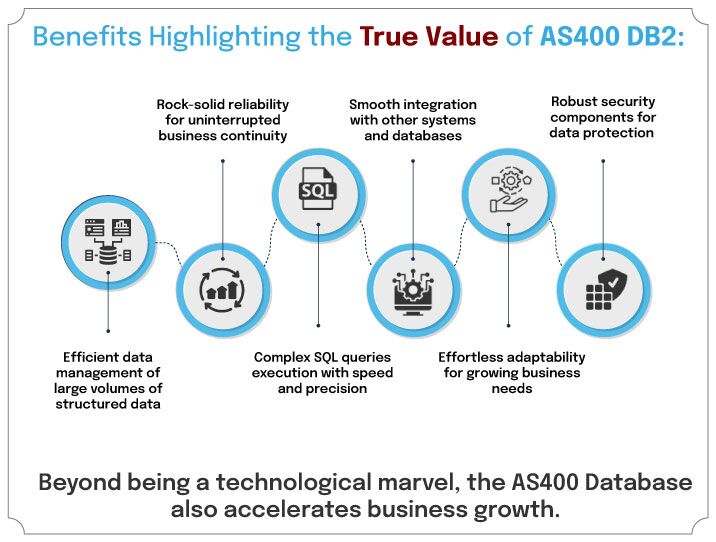
- AS400 is known for its reliable software and hardware architecture. Its impact gets doubled when paired with DB2, enabling a one-stop, reliable database environment
- AS-400 is renowned for its limitless scalability for catering to changing processing needs. With IBM AS400 DB2, you are empowered to manage the growing data needs, making it ideal for SMEs
- The combination of AS400 Db2 database delivers high performance as it includes standardized query optimization techniques, properly designed indexes, reduced need to read data from disk, and dividing the workload among multiple processors
- As compared to systems where databases are maintained separately, administration is easier for AS400 DB2
- DB2 for AS400 offers robust built-in security features such as data encryption and role-based access control
3. What Type of Database Does AS400 Use and How it Compares to other Database Management Systems?
AS400 (now IBM Power Systems) relies on IBM DB2 for i; which is an integrated database management system into IBM i (operating system) itself. By design its reliable, secure and offers native support for both traditional record-level access and SQL.
IBM DB2 for i isn’t an add-on or individual database system, but an integral part of the AS400 architecture. This elevates the security and performance DB2 offers.
Features of IBM DB2 for i
- DB2 for i stores data in tables with rows and columns
- DB2 for i is integrated directly into the operating system unlike traditional databases
- It enables both legacy applications to function beside modern web services through support for native record level access and SQL
- It offers in-built journaling feature for data recovery, stringent security through row/column level access control, and automated storage management
- The new version of Database 2 is armed with AI-dedicated capabilities designed to manage and structure intricate data
- Db2 for IBM i extends support to private and cloud ecosystems
- It makes a better choice if you are an IBM i user as Db2 for IBM i is tightly combined with the IBM i operating system
- DB2 on AS400 comes with data compression technology to help you minimize storage requirements, leading to cost savings and smoother performance
- AS400 database is also known for its ability to efficiently manage large data sets, ensuring faster and more responsive data operations
| Feature | AS400 DB2 (Db2 for i) | Oracle / SQL Server |
| Integration | Built into IBM i operating system | Runs separately on top of OS |
| Maintenance | Lower maintenance, self-managing capabilities | Higher tuning and DBA dependency |
| Storage Model | Object-based, single-level storage | Traditional file-system storage |
| Data Access | SQL + native record-level access | Primarily SQL-based access |
| Best Fit | ERP, finance, inventory, high-volume transactions | Web apps, cloud workloads, distributed systems |
| Operational Focus | Stability and long-term continuity | Flexibility and rapid scaling |
How Does AS400 DB2 Improve Database Performance?
AS/400 DB2 is capable of handling high-volume structured data with speed and consistency.
Its performance advantages include but are not limited to –
- Efficient indexing techniques
- High transaction processing efficiency
- Support for multi-processor workloads
- Query optimization for faster execution
- Reduced disk reads through integrated architecture
In environments where reliability and performance are crucial, these capabilities make AS/400 DB2 crucial.
4. What is the Difference Between AS/400 DB2 and SQL?
The key difference between AS/400 DB2 and SQL is that one is a relational database management system deployed on IBM i(operating system) and the other is a query language used to communicate with it. They don’t compare to being precise, rather they coexist.
“A lot of confusion comes from treating DB2 and SQL as interchangeable. In practice, one is the database platform and the other is the language used to work with the data inside it.”~ Mike Crowley | Director of Customer Success – IBM i | Integrative Systems
Database 2 and SQL are 2 different sides of the same pole; thus, they are not directly comparable. Each of them serves different needs for your database management needs.
What is AS/400 DB2 Database?
AS/400 DB2 (now DB2 for i) is a database management system integrated within IBM i (operating system). It enables you to store, retrieve, and manage data effectively.
There are multiple versions of DB2 designed for different needs –
- Db2 for z/OS (mainframes DB2)
- Db2on Cloud (AWS/IBM Cloud)
- Db2 for LUW (Linux, Unix, and Windows)
- Db2 for i (formerly known as DB2 for AS400 databases)
DB2 and SQL complete each other in the world of database management in multiple ways.
What is SQL?
Primarily used to communicate with relational databases, to manage and manipulate data, SQL is a query-driven programming language.
It enables your team with a common set of commands to perform functions like data defining, manipulating, querying, and controlling access.
It is employed to communicate with a variety of Relational Database Management Systems (RDBMS).
SQL makes it possible for developers to write specific queries to execute on different RDBMS platforms consistently.
You must use AS/400 DB2 and SQL in a combination to access both IBM i records and SQL tables at the same time,
| Feature | AS400 DB2 (Db2 for i) | SQL (Structured Query Language) |
| Definition | IBM’s relational database management system on IBM i | Language used to interact with databases |
| Primary Role | Store, manage, and secure data | Create, update, retrieve data as queried |
| System Integration | Built directly into IBM i (OS/400) | Works as a query interface above the database |
| Data Access | Supports SQL and native RPG/DDS access | Standard access method across modern databases |
| Business Use | Powers ERP, finance, inventory, and transactional systems | Used for reporting, querying, and data analysis |
It’s flagging standard names.
5. What Type of DBMS is DB2?
DB2 for IBM i belongs to the Relational Database Management Systems family by IBM. It’s used to store data in connected tables. It relies on SQL to search, retrieve, process, and manage data across applications.
In IBM i environments, DB2 for IBM i is part of the operating system itself, which is one reason many companies use it for long-running transactional workloads.
There is a variety of DBMSs including, relational databases, object-oriented databases, hierarchical databases, network databases, and graph databases, etc.
IBM DB2 AS400 falls under the relational databases category because it stores and provides access to different data points that are related to each other.It is based on the relational model which makes it easy to see and understand how your diverse data structures are related to each other.
What Kind of Database is DB2?
- Uses SQL for querying and managing data
- Supports both transactional and reporting workloads
- A relational database built around tables, rows, and relationships
- Available across IBM i, mainframe, Linux, UNIX, and Windows platforms
Why does DB2 Matter?
- Handles large transaction volumes consistently
- Known for stable uptime and reliable data processing
- Common in ERP, banking, inventory, and manufacturing systems
- Works with APIs, analytics tools, and cloud-connected environments
- Supports older RPG-based applications alongside newer integrations
A lot of organizations continue using AS400 DB2 databases because the platform keeps core operations running without constant restructuring or heavy administration.
What does AS400 Database Administration Involve?
AS400 database administration undertakes database performance, security, data integrity, and availability.
The key responsibilities include but not limited to –
- Security auditing and compliance
- Monitoring database performance
- Backup and recovery management
- Database optimization and indexing
- Supporting integrations and upgrades
- Managing user access and permissions
6. Can AS/400 DB2 Integrate with Existing Systems and Applications?
AS/400 DB2 integrates well with modern applications and cloud platforms. Though it’s a part of the IBM i legacy infrastructure, IBM i offers advanced tools, open standards, and APIs that enable its integration with external systems.
However, the success rate depends on various factors such as compatibility, level of security, shape of your existing system, and more.
Ask yourself these 5 questions to decide better –
- Are my existing systems and applications compatible with AS 400 databases in terms of data formats and protocols?
- Do AS/400 databases provide APIs or connectors for integration with my existing systems?
- What is the strategy for data synchronization between AS400 database and my existing systems?
- How will I manage security and authentication to protect data during the integration?
- Can the AS 400 database meet the performance and scalability requirements of my existing systems?
Answer these questions carefully and determine the integration capability yourself. It’s recommended to seek help from AS400 consulting experts who have precise knowledge of the context.
What Are Common Applications of DB2 for IBM i?
DB2 for IBM i supports a wide range of enterprise applications across industries.
Common use cases include –
- ERP and financial systems
- Customer management applications
- Inventory and warehouse management
- Manufacturing and supply chain operations
- Reporting and business intelligence platforms
Many organizations continue to rely on DB2 because it supports stable, high-volume business operations.
7. Can AS400 DB2 Be Hosted on the Cloud?
AS400 DB2 (now DB2 for i) can be hosted on the cloud. It allows you to move existing IBM i applications and workload to cloud platforms. By moving your DB2 workloads to cloud, you experience improved scalability, faster disaster recovery, and limitless flexibility.
What are the Different Ways to Host DB2 on AS400 in Cloud?
- Running IBM i workloads through IBM Power Virtual Server (PowerVS)
- Hosting IBM Power Systems through managed cloud providers
- Using IBM i environments on platforms connected with Azure or Google Cloud infrastructure
- Migrating selected workloads while keeping core RPG applications intact
What are the Advantages of Moving AS400 DB2 to Cloud?
- Limit on-premises hardware dependency
- Scale storage and compute resources more easily
- Improve backup and disaster recovery capabilities
- Connect DB2 for IBM i with analytics, APIs, and cloud applications
- Support gradual modernization instead of full system replacement
Many companies do not completely rebuild their systems during migration. Instead, they move existing AS400 DB2 databases to cloud-hosted IBM i environments while continuing to run current ERP, finance, and inventory applications.
“Cloud adoption in IBM i environments is usually gradual. Most organizations move workloads strategically while preserving the applications already tied to business operations.”
~ Mike Crowley | Director of Customer Success – IBM i | Integrative Systems
8. Why is AS400 DB2 Still Relevant for Modern Businesses?
Companies still use AS400 DB2 because the platform continues to run important business systems without creating constant operational issues. In many organizations, the database behind finance, inventory, ERP, or order processing is still DB2 for IBM i.
One reason is reliability. These systems are expected to stay available for long hours, process transactions consistently, and handle large amounts of operational data without frequent intervention.
DB2 competes with multiple top brands of RDBMS. Its unique strength is its impressive integration with IBM POWER8 server architecture. This position allows it to maintain a stable and unchanged future.
The audience that will continue to use DB2 for AS/400 databases will mostly be legacy users and small and mid-sized businesses, users with applications tightly integrated with DB2 for IBM i, and businesses without the need for immediate migration.
With cloud migration the future of IBM DB2 for AS400 has brightened and become more promising. The cloud environments provide seamless integration with other systems, robust security measures, and adaptation to the evolving technology trends, ensuring the long-term relevance of AS400 database.
Why Businesses Continue Running DB2 for IBM i?
- Existing RPG and ERP applications still work reliably
- IBM i environments are known for stable transaction processing
- The database is already integrated into the operating system
- Many workloads run for years without major restructuring
- Modern APIs, analytics tools, and cloud services can still connect to the platform
A lot of modernization projects today are not replacing AS400 DB2 databases entirely. Businesses are instead extending the systems they already trust while gradually updating interfaces, integrations, and reporting layers around them.
Why Choose Integrative Systems for AS400 DB2 Services?
We are all-in-one AS400 DB2 service providers with over 25+ years of experience helping businesses manage, modernize, and optimize IBM i environments.
The fact that we are an IBM Silver Business Partner and INC 5000 ‘One of America’s Fastest Growing Company’ is the best benefit of partnering with us for your AS400 db2 needs.
We help you succeed first by focusing on solutions that improve operational reliability without forcing disruptive system changes.
Over the years, we have acted as extension of in-house teams for businesses that rely on IBM i systems to support ERP, finance, inventory, and transactional workloads.
We map your goals with our expertise to support –
- AS400 DB2 database administration and optimization
- SQL performance tuning and reporting improvements
- Ongoing support and long-term system maintenance
- RPG application support and modernization
- IBM i integration, APIs, and cloud readiness
Our approach is rooted in continuity, scalability, and practical modernization, no matter if you’re planning to modernize your legacy applications or extend the life of your existing DB2 for IBM i applications.
We are committed to delivering solutions you can rely on for continued IBM i operations where performance, uptime, and consistency remain critical.
Drop us a line at contact@integrativesystems.com to get started.




7 Comments to “Top AS400 DB2 Questions Answered for Better Understanding”
Moore
This post really highlights the strengths of AS400 DB2! I love how it emphasizes its reliability and scalability for modern businesses. It’s fascinating to see how a technology with such a long history continues to evolve and meet contemporary needs. Looking forward to more insights on its future developments!
Terry Jordan
This post really highlights the unique advantages of AS400 DB2! I especially loved the emphasis on its reliability and scalability for modern applications. It’s interesting to see how it continues to evolve and stay relevant in today’s tech landscape. Looking forward to more insights on this topic!
Christopher
Great insights! I’ve always been curious about the DB2 capabilities within AS400. It’s fascinating to see how its robustness and security features can potentially outshine other database technologies. Looking forward to seeing how it evolves in the future!
Mason
Great insights! I appreciate how you highlighted the robustness and reliability of AS400 DB2. It’s fascinating to see how it continues to evolve and meet modern database demands. Excited to see where this technology heads in the future!
Samantha Long
Great insights! I never considered AS400 DB2 in the context of modern database technology. It’s fascinating how its robustness and reliability can still lead the way in today’s evolving landscape. I’m looking forward to seeing how it adapts to new challenges in the future!
Michael Reed
Great insights! I’ve always been curious about the longevity of AS400 DB2, and your post really highlights its strengths in modern database management. It’s fascinating to see how it adapts to new technologies while maintaining its core reliability. Looking forward to more updates on this topic!
Zachary Lee
This post really highlights the strengths of AS400 DB2! It’s impressive how its robustness and scalability position it as a frontrunner in database technology. The insights on integration with modern applications were particularly eye-opening. Looking forward to seeing how this evolves in the coming years!